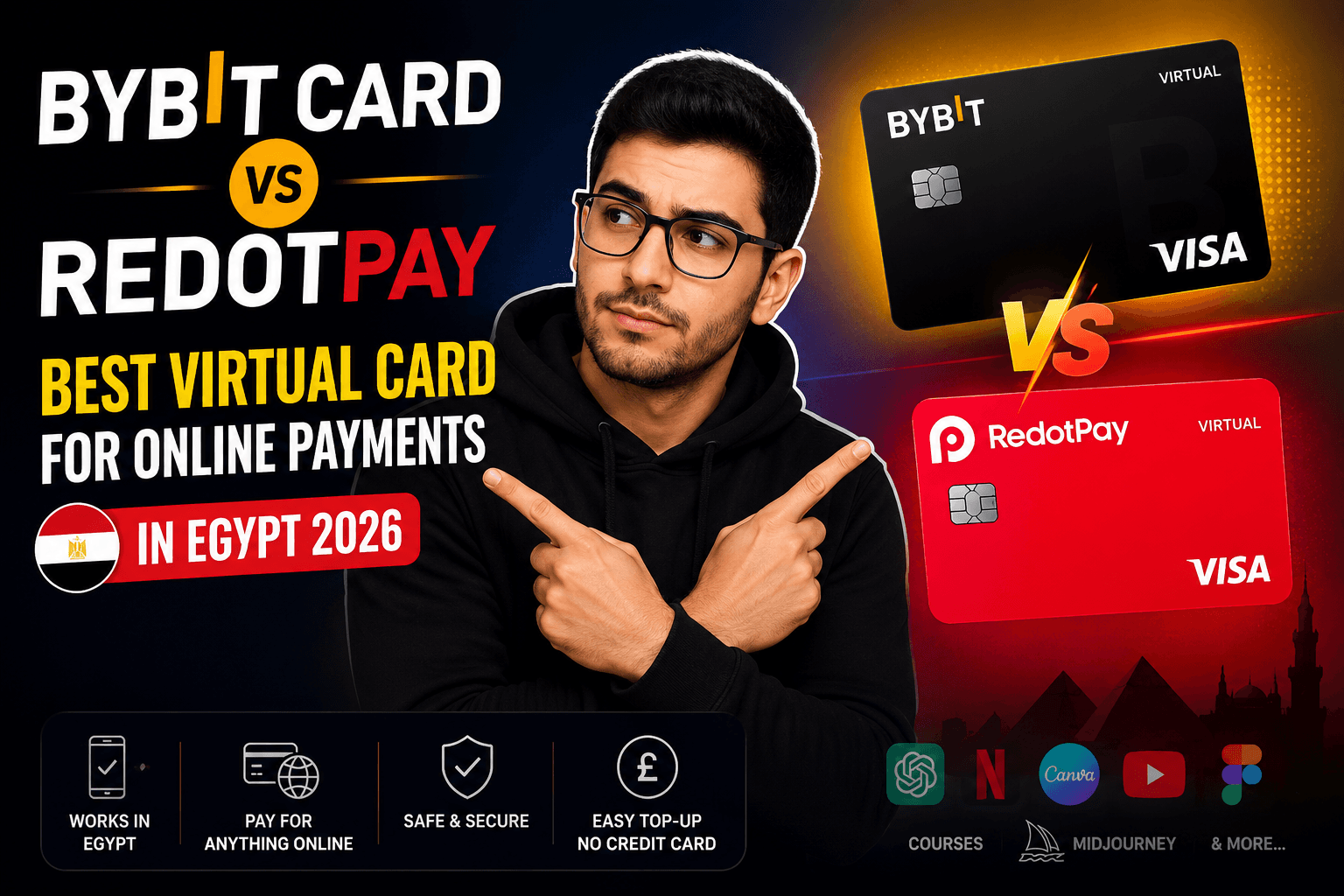
VoyIf you live in Egypt and try to pay for services like Netflix, Spotify, Steam, Amazon, or online courses on Udemy, you have probably hit the same wall many people do: local debit cards are often rejected for international payments. This single problem blocks students from buying courses, freelancers from paying for tools, and everyday users from subscribing to the apps they love. Two popular solutions fix this problem — the Bybit Card and RedotPay. Both let you create a virtual Visa or Mastercard that you fund with crypto or an e-wallet and then use anywhere online.
In the video below I compare Bybit and RedotPay side by side to help you decide which virtual card is the better choice for online payments in Egypt in 2026. I look at fees, funding options, supported services, ease of setup, and the overall day-to-day experience, so by the end you will know exactly which card fits your situation.
Why you need a virtual card in Egypt
Most global platforms only accept international Visa or Mastercard payments. Many local Egyptian cards are blocked for these transactions, or they work for a while and then suddenly stop, which makes them unreliable for anything important like a monthly subscription or a course you are halfway through. A virtual card funded through crypto solves this by giving you a real card number that works worldwide, without needing a traditional bank credit card or a large minimum balance.
Beyond simply working, a virtual card also gives you more control. You can top it up with only the amount you plan to spend, which limits your risk if a website is ever compromised. You can keep it separate from your main bank account, and you can create it in minutes from your phone. For a lot of people in Egypt, this is the difference between being locked out of the global internet economy and taking full part in it.
What is the Bybit Card?
The Bybit Card is a card linked to the Bybit crypto exchange. You keep a balance in your Bybit account and the card lets you spend it directly for online purchases. Because it is connected to a full exchange, it is a natural fit if you already trade or hold crypto on Bybit, since your funds are already in one place and ready to spend.
Pros of the Bybit Card
- Funded straight from your Bybit account balance
- Works for most international online services
- Convenient if you already use the Bybit ecosystem
- Backed by a large, well-known exchange
Things to keep in mind
- You need a verified Bybit account first
- The setup is a little heavier because it is a full trading platform
- Card availability and limits can depend on your verification level
What is RedotPay?
RedotPay is a dedicated crypto payment card service. It focuses on one thing: giving you a virtual card you can top up and spend online. Signing up is quick, and at the time of the video RedotPay offers a free virtual card plus a 5 dollar sign-up bonus, which makes it very easy to try with almost no risk. Because the whole product is built around payments rather than trading, the experience feels lighter and more beginner friendly.
Pros of RedotPay
- Free virtual card to get started
- 5 dollar welcome bonus (as shown in the video)
- Simple top-up and checkout flow
- Fast onboarding, ideal for first-time users
Things to keep in mind
- It is a payment service, not a full exchange, so trading features are limited
- You still fund it with crypto, so you need a way to buy a small amount
- Always check current top-up and transaction fees inside the app
Bybit Card vs RedotPay: the key differences
Both cards solve the same core problem, but they feel different in daily use. Here is a quick side-by-side summary to make the comparison clear:
| Feature | Bybit Card | RedotPay |
|---|---|---|
| Best for | People already trading or holding crypto on Bybit | Anyone who just wants a virtual card fast |
| Sign-up cost | Free (needs a Bybit account) | 10$ per card |
| Welcome bonus | None highlighted | 5 dollar bonus (per the video) |
| Funding | Instapay, Vodafone cash, and more | Instapay, Vodafone cash, and more |
| Ease of setup | Moderate (full exchange) | Very simple |
| Ecosystem | Trading, savings, and more | Focused on payments |
Fees and limits to watch for
No card is completely free once you look at the details, so it is smart to understand the costs before you commit. With both Bybit and RedotPay, the main things to check are the top-up fee (what you pay to move money onto the card), the transaction or foreign exchange fee applied at checkout, and any monthly or issuance fee. These numbers change over time, so always confirm the current rates inside each app rather than trusting an old screenshot.
Limits matter too. Some cards cap how much you can load per day or per month, and higher limits may require extra verification. If you only plan to pay for a few subscriptions, low limits will not bother you. But if you intend to buy expensive courses or software, check the ceilings first so you are not surprised at checkout.
Where you can actually use these cards
Because both are standard virtual Visa or Mastercard numbers, they work almost everywhere that accepts international cards. In practice, people in Egypt use them for services like:
- Streaming: Netflix, Spotify, YouTube Premium, and Disney Plus
- Gaming: Steam, PlayStation Store, and in-game purchases
- Shopping: Amazon and other international stores
- Learning: Udemy, Coursera, and other course platforms
- Work tools: hosting, design apps, and AI subscriptions
A few platforms are stricter than others and occasionally flag prepaid or crypto-funded cards. If one service does not accept your card, it is usually worth trying the other card, since acceptance can differ between providers.
How to stay safe when using a crypto card
- Only top up what you plan to spend soon, so a leaked card number cannot drain a large balance.
- Turn on two-factor authentication on both your card app and your email.
- Never share your card details, one-time codes, or seed phrases with anyone.
- Use official apps and links only, and be careful with lookalike websites.
- Review your transaction history regularly and freeze the card if anything looks wrong.
Common mistakes to avoid
- Loading a huge balance at once instead of topping up as needed.
- Ignoring the top-up and exchange fees, then wondering where the money went.
- Skipping verification and then hitting a low limit at the worst moment.
- Using an unofficial referral link that does not actually give you the bonus.
- Assuming every website will accept the card without testing a small payment first.
Which one should you choose?
If you already use Bybit to trade or hold crypto, the Bybit Card keeps everything in one place and is the more convenient option. Your money is already on the platform, so spending it is only a couple of taps away. This is the smoother path for anyone who is comfortable inside a crypto exchange.
If you are new to all of this and simply want the fastest way to get a working virtual card, RedotPay is hard to beat. The free card and the small welcome bonus mean you can start paying online within minutes, without learning a full trading interface first. For a student who just needs to buy one course, or someone who wants a quick Netflix subscription, RedotPay is the friendlier starting point.
Many people even use both: RedotPay for quick everyday subscriptions, and Bybit when they are already managing crypto on the exchange. There is no rule that says you must pick only one, and having a backup card is genuinely useful when a specific website rejects the other.
How to get started
- Pick the card that matches your needs, or sign up for both to compare them yourself.
- Create your account and complete the simple identity verification.
- Buy a small amount of crypto or use a supported funding method to top up your balance.
- Generate your virtual card inside the app.
- Add the card to your favorite services and test it with a small payment first.
If you want a full step-by-step guide to funding and using Bybit specifically, read How to Make Online Payments in Egypt Without a Credit Card Using Bybit.
Frequently Asked Questions
Are Bybit Card and RedotPay available in Egypt?
Yes. Both services work for users in Egypt and let you pay international platforms that normally reject local cards.
Do I need to own crypto to use them?
You fund both cards with crypto, but you do not need to be a trader. You can simply buy a small amount, top up the card, and spend it like a normal Visa.
Which card is cheaper to use?
Fees vary over time, so always check the current rates inside each app. RedotPay lowers the entry cost with a free card and a welcome bonus, while Bybit is convenient if your money is already on the exchange.
Can I use these cards for Netflix, Steam, and Udemy?
Yes. Because they are standard virtual Visa or Mastercard numbers, they work with Netflix, Spotify, Steam, Amazon, Udemy, and most other online services.
Is it safe to use a crypto-funded card?
It is safe when you use official apps, enable two-factor authentication, and only load what you need. Treat it like any other card and keep your details private.
Can I get a physical card as well?
Depending on your region and verification level, a physical card may be available, but for online payments, a virtual card is all you usually need.
How long does setup take?
RedotPay can be ready in just a few minutes, while Bybit takes a little longer because it is a full exchange with its own verification steps.
Final thoughts
Both the Bybit Card and RedotPay are excellent ways to pay online from Egypt without a traditional credit card. They remove the frustration of rejected payments and open the door to the same services people use everywhere else in the world. The right choice mostly comes down to how you already manage your money: pick Bybit if you live inside a crypto exchange, and pick RedotPay if you want the simplest possible card.
Watch the full comparison above, then choose the option that fits your situation, or grab the free RedotPay card to start immediately and add Bybit later as your needs grow. Whichever you pick, you will finally be able to pay for the services you want without hitting that all-too-familiar declined message.